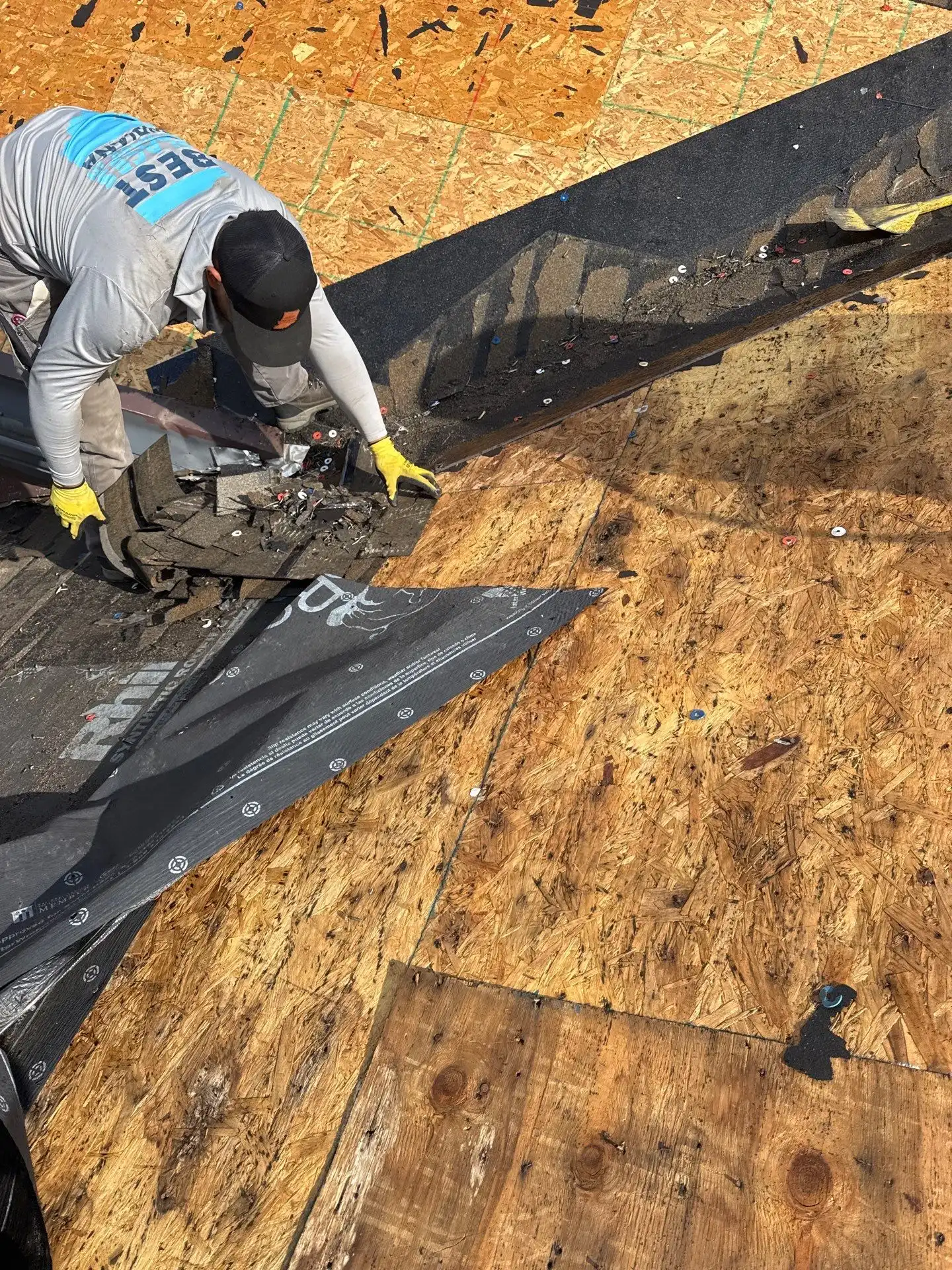
Tear-Off, Recover, and the Existing Roof
What happens to the old roof, and what condition it is in, significantly affects the replacement cost. Understanding this explains a major cost factor. Here is how tear off, recover, and the existing roof affect cost on a Daleville commercial building.
The Cost of Tear-Off
Tearing off the old roof adds cost, since removing the deteriorated layers down to the deck requires labor and disposal. The tear off is a real expense that recovering can sometimes avoid. For a Daleville building, the cost of tear off is a factor, since removal and disposal take labor and money. The tear off adds to the price. This cost of tear off adds to the replacement, since removing the deteriorated old roof down to the deck requires labor and disposal, making the tear off a real expense that factors into the cost of a flat roof replacement on the commercial building.
Recover as a Lower-Cost Option
Recovering can be a lower cost option, applying a new roof over a suitable existing one to avoid the tear off, sparing its cost and labor. When the existing roof qualifies, recovering can reduce the cost. For a Daleville building, recover as a lower cost option can save money, since it avoids the tear off. The recover skips the removal cost. This recover as a lower cost option can reduce the cost, since applying a new roof over a suitable existing one avoids the tear off, sparing its cost and labor when the existing roof qualifies for a recover on the commercial building.
When Tear-Off Is Necessary
Tear off is necessary when the existing roof is too far gone to recover, with wet insulation, deck damage, or too many existing layers, since building over those problems would compromise the new roof. Sometimes the added cost of tear off is unavoidable and worth it. For a Daleville building, understanding when tear off is necessary explains the cost, since some roofs cannot be recovered. The condition requires the tear off. This understanding of when tear off is necessary explains a cost driver, since the existing roof being too far gone to recover, with wet insulation, deck damage, or too many existing layers, makes the tear off necessary because building over those problems would compromise the new roof on the commercial building.
Addressing Wet Insulation and Deck Damage
Addressing wet insulation and deck damage adds cost, since any wet insulation or damaged deck exposed during the work must be repaired or replaced for the new roof to perform. This added work increases the cost where it is found. For a Daleville building, addressing wet insulation and deck damage is a cost factor, since the problems beneath must be fixed. The repairs add to the price. This addressing of wet insulation and deck damage adds cost, since any wet insulation or damaged deck exposed during the work must be repaired or replaced for the new roof to perform, increasing the cost where these problems are found on the commercial building.
The Code Limit on Layers
The code limit on layers affects the choice, since building codes typically limit a roof to a certain number of layers, often two, after which a tear off is required rather than another recover. This can force a tear off and its cost. For a Daleville building, the code limit on layers is a factor, since it can require a tear off. The code may mandate removal. This code limit on layers affects the cost, since building codes typically limit a roof to a certain number of layers, often two, after which a tear off is required rather than another recover, which can force a tear off and its added cost on the commercial building.
An Assessment Determines the Approach
Because the right approach depends on the existing roof, an assessment determines the approach, evaluating the roof's condition and layers to decide whether a recover or tear off is appropriate and what the work requires. The assessment is necessary to know the cost. For a Daleville building, an assessment determines the approach, since the existing roof's condition drives the decision. Daleville Commercial Roofing assesses before recommending. This assessment determines the approach, since the right path depends on the existing roof, and evaluating its condition and layers to decide whether a recover or tear off is appropriate and what the work requires is necessary to determine the cost on the commercial building.
The Existing Roof's Effect on Cost
The existing roof affects cost through whether a tear off is needed, with recover as a lower cost option when the roof qualifies, tear off necessary when it is too far gone or at the code layer limit, and wet insulation or deck damage adding cost. An assessment determines the approach on a Daleville commercial building.
It helps to understand why getting an accurate estimate requires an assessment rather than a phone quote. Roof replacement cost depends on so many specifics, the roof size, the existing roof's condition, the complexity, the access, the insulation, and more, that a number given without seeing the roof is necessarily a guess. The condition of what lies beneath the old roof, in particular, often cannot be fully known until the roof is assessed, since wet insulation or deck damage may be hidden. For a Daleville building, this means a real estimate comes from a contractor measuring and evaluating the actual roof and project. Daleville Commercial Roofing provides a free assessment for this reason, since an accurate, itemized estimate that you can budget around requires understanding the specifics of your roof rather than applying a generic figure that may turn out to be far off for the commercial building.
Find Out What Your Roof Needs
Wondering whether your roof needs a tear off or can be recovered? Call Daleville Commercial Roofing at (765) 676-3491 for a free estimate on your Daleville commercial building. We assess your existing roof to determine the right approach and give you an honest cost that reflects what your roof actually needs.